Wondering whether “irrigated acreage” in Stevensville means a true working asset or just a promising line in a listing? That is a smart question to ask before you buy. If you are looking at land in the Bitterroot Valley, you need to understand not just how many acres are on paper, but how the water is delivered, what rights transfer, and how the layout works in real life. Let’s dive in.
Why irrigation matters in Stevensville
Stevensville sits in one of the most irrigation-dependent parts of the Bitterroot Valley. The federal Bitter Root Project supplies irrigation water to 16,700 acres of bench lands around Stevensville, and local planning documents identify the Supply Ditch as the primary irrigation ditch in the Stevensville planning area.
That local context matters because irrigation here is not a rare extra. It is part of how many small farms, hay fields, and pasture properties function. Ravalli County also has more than 100,000 irrigated acres, which gives you a sense of how central water delivery is to land use in this area.
Irrigation supply is seasonal and depends on snowmelt, tributaries, and reservoir regulation. Stevensville’s growth policy notes that Bitterroot River flows vary with rainfall and snowmelt and are influenced by Painted Rocks Reservoir, so water conditions can change throughout the season.
Know the difference between land and water rights
One of the biggest mistakes buyers can make is assuming irrigated land automatically comes with a clear, usable water right. In Montana, a water right is a property right to use water, not to own the water itself. That right includes specific elements such as the source, point of diversion, place of use, period of use, period of diversion, and priority date.
Montana follows prior appropriation. That means senior rights are satisfied before junior rights when supply is tight. So if you are counting on late-season irrigation, the priority date and actual delivery history can matter a great deal.
It is also important to understand that ditch rights and water rights are not the same thing. Ditch rights can be separate property interests tied to the ditch corridor and maintenance access, and they may allow access across private land for upkeep.
What buyers should verify before closing
If you are looking at irrigated acreage in Stevensville, your due diligence should go beyond a quick glance at green pasture. The key is to confirm what actually transfers with the sale and whether the records match what you see on the ground.
Start with the deed. MSU guidance for buyers recommends reviewing the deed for any severed water rights and confirming the status of shares with the ditch company or irrigation district.
You also want to verify that annual assessments are current. Shared irrigation systems are usually maintained by ditch owners or water users, not the public, so unpaid assessments or unresolved issues can become your problem after closing.
Here are some practical questions to ask:
- What organization delivers the water to the parcel?
- Are the water rights or shares included in the sale?
- Are there unpaid assessments or compliance requirements?
- Do the deed, claim abstract, and Water Resources Survey maps describe the same irrigated acres?
- Does the current irrigation pattern match the historic use?
- Is the water supply reliable in late summer?
- If the right is a post-June 30, 1973 permit, has it been perfected and does current use match the permit?
Why a site visit matters
Paper records are only part of the story. A real field visit can tell you whether the system actually works the way the listing suggests.
MSU’s buyer guidance recommends comparing current irrigation to the claim abstract and historic use. A late-season visit can be especially useful because that is when you are more likely to see whether delivery holds up when demand is highest.
Bring the right mindset to the showing. If a field appears irrigated in early summer, that does not automatically tell you what conditions look like later in the season.
This is one area where local, boots-on-the-ground guidance can make a real difference. Looking at ditch alignment, wet spots, field slope, turnout locations, and practical access often tells you as much as the paperwork does.
Understand the physical irrigation system
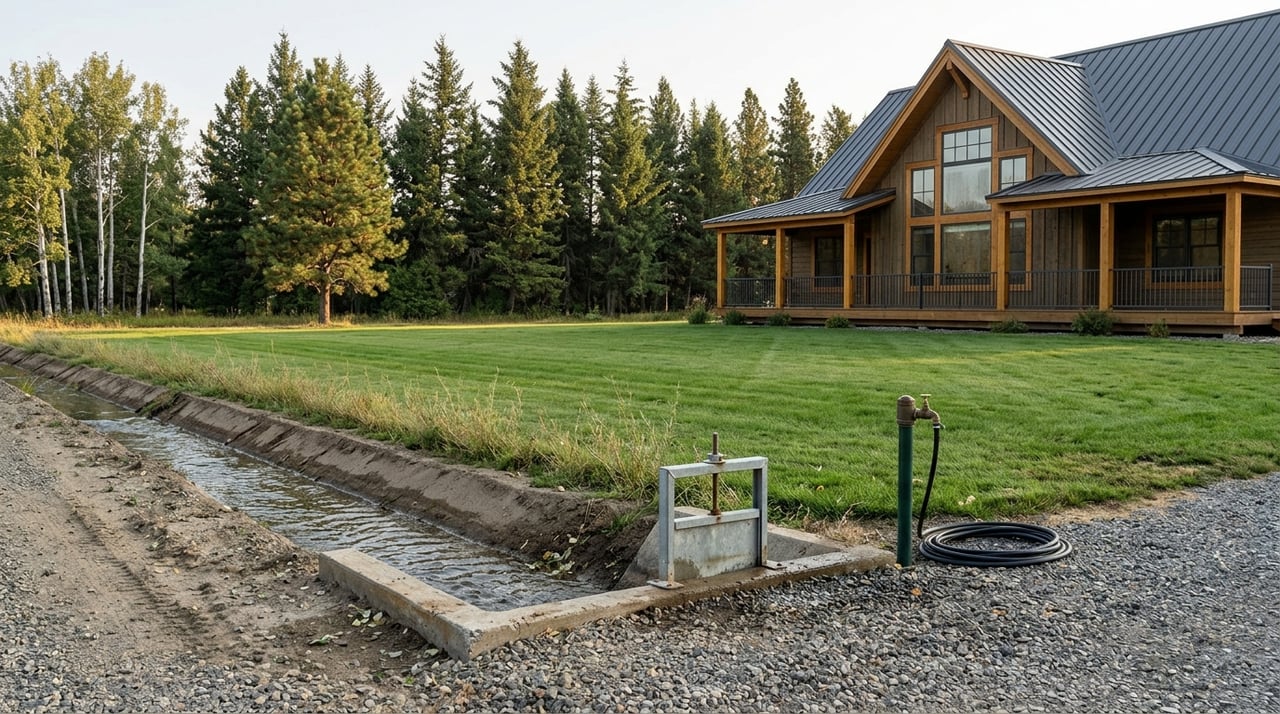
On acreage near Stevensville, irrigation is usually a system, not a single feature. You may see some mix of ditches, canals, laterals, headgates, flumes, turnout structures, pumps, pipelines, or sprinkler components.
In the Bitter Root Project, water is stored at Lake Como, diverted at Rock Creek Diversion Dam, and carried through a canal along the bench lands east of the Bitterroot River. That larger network helps explain why local parcel-level systems can be more complex than they first appear.
You should also find out whether the property was designed for flood irrigation, sprinkler irrigation, or a mixed system. Each setup affects labor, field layout, and water management in a different way.
If a ditch crosses the property, do not assume you can move it, fill it, or modify it freely. MSU Extension says landowners should contact ditch owners before doing work on an irrigation ditch, and maintenance access may exist across private land.
Field layout matters as much as acre count
Not all irrigated acreage is equally usable. A property may have a certain number of irrigated acres on paper, but the field shape, slope, drainage, and access can make those acres easier or harder to manage.
MSU Extension notes that irrigated pasture works best with high-quality water and soils that are deep, well-drained, and suited to irrigation management. Topography also needs to fit cultivation and water handling, which is why shape and slope matter as much as raw size.
In the Stevensville area, planning documents describe homesteads and small farms with irrigated hay fields and grassy rangelands beyond town. They also note that hay and alfalfa fields often line creeks and irrigation ditches where moisture exists year-round.
That means buyers should pay close attention to how the ground actually lays out. A narrow, oddly shaped field with drainage issues may perform very differently from a well-shaped parcel with practical access and a clean irrigation pattern.
Pasture use takes planning
If you are buying acreage for horses, livestock, or forage, irrigation affects how you will use the land day to day. Irrigated pastures can support higher forage production and more intensive grazing than dry acreage, but they also require more active management.
MSU Extension describes irrigated pastures as high-yield forage land whose productivity improves with better grazing rotation, fertilization, and irrigation discipline. Seeded or irrigated pastures also tend to handle grazing differently than native rangeland.
Layout becomes very important here. MSU recommends fencing seeded pastures separately from native rangeland and from one another so you can rotate and rest them independently.
For buyers, that means looking beyond the water source alone. Cross-fencing, paddock setup, equipment access, and overall management flow all affect how useful the property will be for your goals.
Irrigation can affect drainage and site conditions
Irrigation is not just about watering a field. It can also shape broader site conditions over time.
Montana State University notes that irrigation ditches can recharge groundwater and wetlands. In practical terms, that can influence surrounding soils, drainage patterns, and moisture conditions across the property.
This is worth watching during a showing. Wet areas, soft ground, or persistent moisture near ditches may be part of the long-term behavior of the site, not just a temporary condition.
For a buyer, that is another reason to look carefully at the land itself and not rely only on the listing description. Long-term usability depends on how the water system interacts with the ground.
Converting irrigation methods is not simple
Some buyers see an older flood-irrigated parcel and assume converting to sprinklers will always be an easy upgrade. That assumption can lead to surprises.
MSU’s buyer guide cautions that switching from flood irrigation to sprinklers is not automatically a water-conservation win. Sprinklers may allow later-season diversion, cover more of the field, and reduce return flows, so the effect is site-specific.
That means any planned change should be evaluated carefully against the existing water right, system design, and on-the-ground conditions. What sounds efficient in theory may not match the property’s legal setup or practical performance.
What irrigated acreage can mean for value
Irrigated acreage is more than extra land. In Stevensville, it often represents land plus a water right plus delivery infrastructure plus maintenance obligations.
That is why the marketability of irrigated property depends on more than a seller’s description. Documented historical use, reliable delivery, and the condition of the ditch or irrigation system all help shape how useful and appealing the property may be.
There is also an important difference between a paper water right and a real-world usable right. MSU’s buyer guide explains that the right described on paper may be broader than what can actually be documented as historically used.
So before you assign value to “irrigated acres,” make sure the abstract, maps, deed language, and visible use all line up. That is where a careful review can protect both your budget and your plans for the property.
A smart way to evaluate Stevensville acreage
The best way to evaluate irrigated acreage in Stevensville is to break it into three parts. First, review the paper right. Second, understand the physical delivery system. Third, walk the actual land and see whether the layout supports your intended use.
When those three pieces line up, you can feel more confident about what you are buying. When they do not, you may need more answers before moving forward.
If you are comparing dry acreage with irrigated acreage, the real question is not simply whether irrigation exists. The better question is whether the parcel has a reliable, documented, and usable supply that fits the way you want to use the land.
If you want help evaluating acreage, water delivery clues, access, and on-the-ground property issues in the Bitterroot Valley, reach out to Wanda Sumner. She brings local market knowledge and hands-on land insight to help you buy with more confidence.
FAQs
What should buyers verify about irrigated acreage in Stevensville, MT?
- Buyers should verify whether the water rights or shares transfer with the sale, whether assessments are current, whether deed language matches the claim abstract and survey maps, and whether the current irrigation use matches the historic record.
Why do water rights matter when buying land in Stevensville, MT?
- Water rights matter because in Montana they are separate property rights to use water, and the usefulness of irrigated acreage depends on the source, place of use, priority date, and whether the right is actually documented and deliverable.
What is the difference between a ditch right and a water right in Montana?
- A water right is the legal right to use water, while a ditch right is a separate property interest tied to the ditch corridor and maintenance access for shared irrigation infrastructure.
When should buyers visit irrigated property in Stevensville, MT?
- If possible, buyers should visit late in the irrigation season because it can show whether the water supply still performs when demand is highest.
Can buyers change an irrigation ditch on private property in Stevensville, MT?
- Buyers should not assume they can change a ditch at will, because ditch owners may have maintenance rights and MSU Extension says landowners should contact ditch owners before doing work on an irrigation ditch.
Does irrigated acreage in Stevensville, MT always add value?
- Irrigated acreage can be attractive, but its usefulness depends on documented historical use, reliable delivery, workable field layout, and the condition of the system rather than the label alone.